

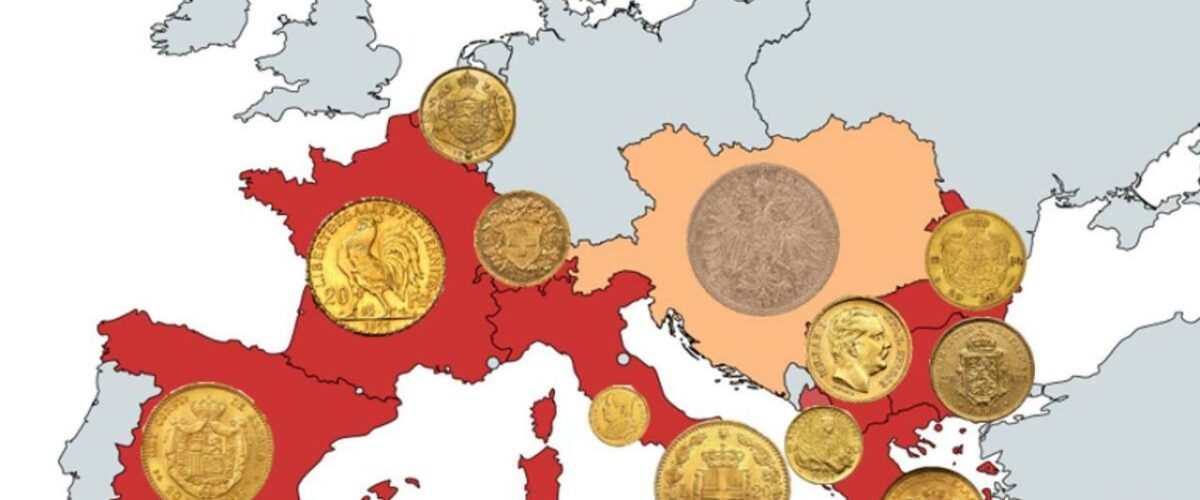
Dear readers Numismatica Ranieri, inside this blog article, we will talk about the Latin monetary union of the Italian and, more specifically, the circulation of the various coins in the Italian territory in the course of history. Good read.
Latin monetary union Italian
The introduction of the euro, the currency of the european Union, it was thought that it could create problems to the common people, but in a few years, the new currency has caught without creating major difficulties by replacing the old lira, the Spanish peseta, the franc, the mark, the shilling, and other currencies after a remarkable and glorious use – with regard to the lire – about twelve centuries and establishing itself even with its value as an international currency.
If we think of other similar changes in the currency of the past (even if little known), we can compare these to assimilate to those of our historical period (the replacement of monetary desired by civilized peoples of Europe), but we can imagine, however, what difficulties they may have had, both in ancient times that the most recent of these changes.
After the fall of the roman Empire, when the monetary circulation had had a difficult path with the issue of coins from various mints of the roman, more and more small and of little intrinsic value, which were used in various and multiple ways (for example, the weight of the bronze coins as great as the sestertius and the board to have the currency petite), was the byzantine coin and the coins of the occupation of Italy from the barbarians.
All of these coinage can think of the major difficulties of circulation, with the disorder that could have been created in Italy.
To bring order to the circulation of the various currencies in Italy, Charlemagne towards the end of the EIGHTH century (779 0 781-794) created and put into the course, the new monetary system duodecimale monometallico of silver, based on the lira or pound as a unit of account valid approximately 409 grams of silver (coin, cut into 20 soldi or 240 denari, heavy about g 1.7 of silver, at the beginning, only the nominal current assets). For several centuries, after the fall of the roman Empire, circulated the solid byzantines, nominal gold with its submultiples, semisse and tremisse, used until the end of the Empire of the East.
Delivering, therefore, a libra, or lira of silver, the ticks had to return 240 pence. From here was born the monetary history of the lira, which would last until the beginning of the third millennium interesting, as a unit of measurement of the currency, almost all of the christian west: from the English channel to the court of Aachen, Italy to Rome, where they were in use two systems, the gold byzantine (solid or money) along with the silver (the lyre) of C. Magnus, and the monetary area of the arabs.
The lira will represent the values of 20 soldi or 240 denari until towards the end of the French Revolution, when it was abandoned the system duodecimale for the introduction of the new decimal system is used in almost all of Europe, except Great Britain, that will remain linked to the old system with the pound, equal to 20 Shillings and 240 pence, up to the Seventies of the XX century.
If, during the first century of the coinage of the carolingian there were important innovations in the X century, you can notice the first changes in the value of the lira; money kept in a large way its value in weight, but led to a reduction in the title of silver. Following the title is that the weight fell inexorably to the cause of the impairment.
This shift of weight, and the title is not involved in the lira account that remained at the value of 240 pence, while the weight of the silver, the corresponding decreased significantly, and the lira was worth about 330 gr in the title of 830. With the passing of the centuries, the value of the lira declined continuously, more or less, for several reasons, including the write-down.
But the one that created confusion and difficulties had to be the difference in the value of the lira between the various ticks of Italy.
The values of the lira of two cities like Verona and Pavia, between the TWELFTH and THIRTEENTH centuries, are the following: the first goes from 72 to 27 grams of silver; the second goes from 240 to 96 grams of silver. The areas of the lira imperial Milan, lira veneta, asti, genoa and fiorentina, they are free to all to behave in an independent way.
With a jump of a few centuries, we can show the devaluation by comparing the value of the lira of Venice and MiIano. With the doge Tron (1471-1474) was born in Venice, the first lira silver the effective weight is 6.5 grams of silver with a intrinsic 948 thousand, and very far from the lira to the emperor Charlemagne, grams, it was well-409.
In Milan, in the same period during the reign of Galeazzo Maria Sforza, in 1474 was coined a currency from the up of 962 and a weight of g 9,8 of silver, the lyre of Milan, later called stubborn. In these conditions it was difficult for many governments of Italy to compare the value of their currencies, and this was the case in many other cases.
Problems similar to those created by the new coinage of the carolingian occurred also in the coinage of the Italian after the Risorgimento and the birth of the Kingdom of Italy, as at that time worked numerous ticks of the Governments of the whole of Italy, with nominal very different between them, with metals in different titles were created, especially to people who are illiterate and less educated, and difficulties.
On this occasion, the government, Vittorio Emanuele issued numerous decrees and laws, with tables of information, which gave the value of old coins against the Italian lira. A list of some very eloquent.
Royal decree no. 123 of July 17, 1861, “about the legal status of the Italian lira de’ its multiples and summultipli, and about the course and the information of the coins struck by the retired Governments of the various Provinces of Italy:Article I – The Italian Lira and its multiples and summultipli are legal tender in all the Provinces of the Kingdom of Italy. Coins-decimal gold are allowed to be legal tender, according to the several legislative acts mentioned.Article 2 – The coins struck by the retired Governments will continue temporarily to be legal tender in their respective Provinces. II the course of these coins and their comparison to the Italian lira is regulated and established by the annexed tariff, etc...”.The decree followed the other two articles, and the rate of information in decimal currency, the Italian of the various currencies in the course. The coins were almost all of the Italian territory from the south to the north:
The provinces of Sicily and Naples with, for example: plate or piece 12 carlini neapolitan or 12 tarì sicilian, value of 5 liras, 10 cents.
The provinces of Romagna, Umbria and the Marches, with coins in gold and silver, for example: the shield that title 900/ heavy g 26,898 of silver, the value of 5 lire, 32 cents.The provinces of Tuscany with coins of silver, for example: the francescone or piece paoli 10, from the title of 916/.. heavy g 26,972, value of 5 lire and 60 cents.
The provinces of Modena, silver coins and eroded-mixed, two examples: the shield of Francesco III in silver, the title of 861 /.. heavy g 28,968, value lire 5, 54 cents.; lira of Modena, of the value of lire 1, 30 cents.
The provinces of Parma, with coins in gold, silver and eroded-mixed-for example: the duchy of silver to the title of 902/ heavy g 25,704, value of 5 lire, 15 cent.; another example of eroded-mixed piece 20 money of Parma, the value of lire 1, 20 cents.
The provinces of Lombardy with silver coins and eroded-mixed, for example: the aruban new currency in austria, title 900/.. and heavy g 12,345, the value lire 2, 46 cents.; another example of eroded-mixed, 10 cents of florin, the value 24 cents.; the lira austrian or svanzica new-fangled, value of 86 cents.
Provinces Sardines with coins in gold, silver and eroded-mixed, for example: the four times of Genoa from the title of 909,5/ .. heavy g 25,214, the value of 79 lire, 45 cents.; another example, the shield of old Piedmont, in silver for the title of 904/ heavy g 35,164, value 7 lire, 10 cents.This decree practically runs the whole length of Italy, and relates to all the States up to that time had had its own currency.
On 8 December 1861, the Royal Decree no. 368 approving the type to use for the footprint of the coins of gold and of silver, and he ordered the baggage to the Directorate-general of the Archives of the Kingdom. A decree, that in addition to the types of the coins of both gold and of silver, it also shows the dimensions of the same.
As of December 12, 1861, the Royal Decree no. 370, which determines the ritenenze from farsi from ticks of the State for the manufacture of coins for the refining and partition of the metals, followed by the rate of the ritenenze in force since 1 January 1862.Law no. 506 23 march 1862, which he admits to be legal tender in all the Kingdom's currency to a decimal gold (seems to see the current laws that have admitted to be legal tender in the whole of Europe, the euro and its multiples and sub-multiples).
Law no. 570 April 21, 1862, with which it determines the course of the broken svanzica or lira, austria.
This law and others like ordering coins (austrian pieces of half and a quarter of a svanzica, new and old), in the Provinces of Lombardy may not be able to enter the payments in the proportion of 2% until I January 1863. From January 11 to January 1863 in the next, the same coins, and those that circulated in the former Duchy of Modena will not enter in the payment of less than five liras in italy; the third article gives the values from the italians to the piece of half and a quarter of a lira austrian or svanzica of the old mint, which are respectively 40 and 20 cents.
Another system to promote the use of and, above all, the extinction of the old currency of austria that had circulated in the former Duchy of Modena.
The law of August 6, 1862, authorising the manufacture and issue of bronze coins of 10 and 5 cents, and heavy, respectively, 10-and 5-grams, etc.
Law no. 788 August 24, 1862 about the unification of the monetary system: we find so the technical characteristics (piece, weight, and tolerance) of all the coins issued, starting from 100, 50, 20, 10 and 5 lire d'oro, 5, 2, 1 lira, and the 50 and 20 cents in silver up to pieces from cents 10, 5, 2, 1 bronze; below are some more articles that speak of the title of the metals used, the fingerprint of the coins and diameter, tolerances, of the use of bronze coin only as the fulfilment of the districts of lira, of the possibility to put in the course coins, foreign coins, sheared, broken, or deteriorated to the point of rifonderle why are impossible to use as unreadable.
Evidently, the program of withdrawal of copper coins and currency with the new bronze coins had to be extended, in fact, the Royal Decree no. 834 21 September 1862 speaks of the extension of the withdrawal of the coins up to October 31, 1862. But still something he had to work in the best way given that the Royal Decree no. 986 16 November 1962 stated that the date from apporsi coins divisionarie silver – to be issued in execution of the law, August 24, 1862 described above – that they must be dated 1862, which would bring the date 1863.
Royal Decree no. 1176 12 march 1963), establish the time of termination from the course, legal in the province of Parma of thalers, of the means brief of the parts to be 20 carantani, to start from April 16, 1863.
Another legislative instrument, similar to the Royal Decree No. 1553 of November 29, 1863, ordered the cessation of the legal tender and the withdrawal of the coins of the copper coinage of the tuscan.
II Royal Decree no. 1621, December 27, 1863 sets a deadline for the ritiramento and exchange of the coins of the copper coinage of the sardinian, from February 29 1864, and surrogate with bronze coins from one, two, five and ten cents, and also gives the information to the coins above written, according to the old rates of 1826 and 1842.
Interesting that the Royal Decree no. 1168: march 11, 1963 lays down instead for five years, the exchange rate between the pound sterling and the Italian lira, set to 25, 30 Italian lire for every pound sterling.
II Royal Decree no. 1392, August 2, 1863 sets, finally, a new imprint of the coins divisionarie silver: bring on the reverse, in place of the existing footprint, in the middle of the indication of the respective value between two branches of laurel, and in the top of the legend, the KINGDOM Of ITALY, with all the respective diameters of the logs.
As you can see, therefore, also the change of the coinage of Vittorio Emanuele was neither quick nor easy, and had to undergo changes, delayed, and subject to different statutes and laws that lasted, time and time again, the end date of the exchange of monetary of the new Italy.
Conclusions
Hoping that this dedicated article to find out more details at the idea of the Latin monetary union in the Italian state your interest, we look forward to your opinions.
You can let us know what you think or send us other tips through the space, and comments confidential, or through the contact page. Also for any doubts or queries please visit the contact us section of our website.
For any information or further details of our e-mail address is the following: info@numismaticaranieri.it
To the next one with the best news related to the world of numismatics.