

Dear readers Numismatica Ranieri, in this article of our blog numismatic we will tell you about the history of the tobacco notes, or the coin “cultivated” for dozens of years between the English colonies of North America. The Virginia and Maryland a long time, “cultivated” their currency and not emitted, as it was the tobacco is the main medium of money used. Thanks to a new form of the cultivation of tobacco, which improved the quality and increased the production, established in 1616 by John Rolfe, the territories between Cape Fear and the Potomac river they recorded a great economic development.
The history of the Tobacco notes
The new method of culture devised by Rolfe was that all the economic and social of the colony was determined as a function of the tobacco. Slowly the colony replaced Spain in the supply of tobacco to England, who spent each year for the purchase of this product over pounds.
It was the beginning of the colonists (who in 1618 were just 600 souls, 3.000 just 7 years later), of a new life and a new era of prosperity. The tobacco, with the exports, not only gave work and wealth, but resolved the problem of the currency, and thus becoming the official currency of those regions. Except for rare exceptions, all transactions of a significant amount, fines, taxes, fees, of every kind, were made through the agency of the tobacco; commodity prices were denominated in amounts of tobacco and it was not uncommon for the case in which, if the buyer were offered in payment for coins, you should proceed to the evaluation of the tobacco species, monetary, and determine the arbitrage.
Only for small transactions each day you used the metallic currency, given that the tobacco, although it was an excellent divisibility physical, not had a good divisibility economic; only large loads of product could be advantageously negotiations. In practice, the tobacco circulated both as money and as a commodity.
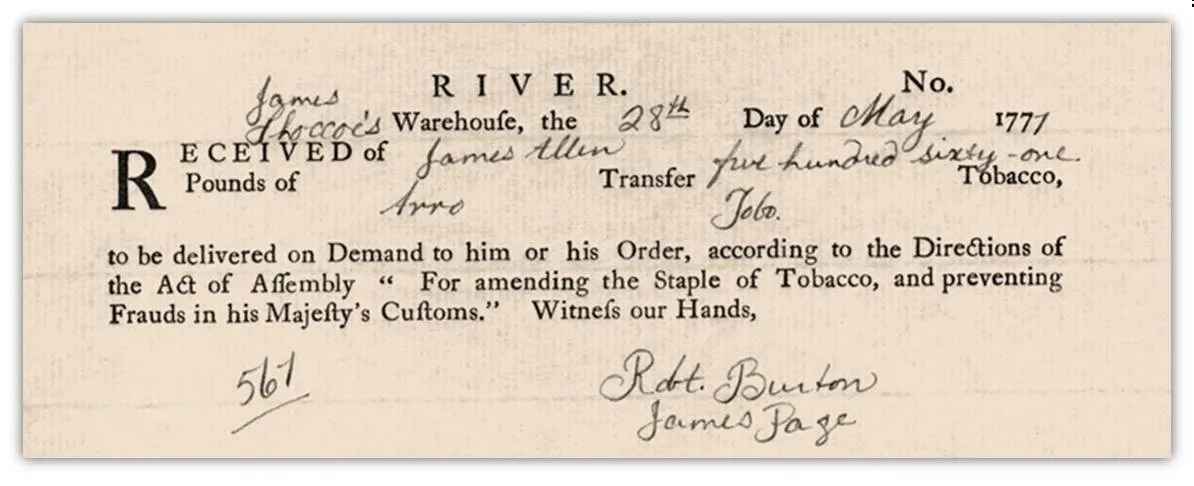
To increase the speed of movement of the tobacco money and to remedy the inconveniences arising from its two defects – the difficult transferability and lack of homogeneity were made up of warehouses public, such as deposits of tobacco behind the release of tobacco noteswhere they recorded the weight, quantity, quality and other requirements of the tobacco received.
These tobacco notesby transferring the ownership of the tobacco that was mentioned, in passing from hand to hand, out of pocket in the pocket, had the function of many coins. But if the tobacco was a medium of exchange within the colony, ceased to be so when it was exported, and was the counterpart of the goods that were imported; there was always a balance that had to be adjusted, at the end, in metallic currency. And only when the tobacco was available to sell (the bid suffered two variations: annual and seasonal), the merchant in the colony, knowing the price, he could know whether he had made a good bargain.
To overcome this drawback, in 1750, he gave his life in Maryland to a new method of bargaining: the farmer of tobacco, for the purchase of imported manufactured goods, was to respond to the merchant colonial in terms of the british currency, assessing the goods to their pure cost in England, plus the cost of transportation and the profit of the merchant.
The spread of this new practice, it marked the end of the function monetary paid by the tobacco, become just a commodity to satisfy its market price, the obligations stipulated in the metallic currency.
Conclusions
Hoping that this article is dedicated to discover the history of the tobacco notes has been of interest to you, waiting for your opinions.
You can let us know what you think or send us other tips through the space, and comments confidential, or through the contact page. Also for any doubts or queries please visit the contact us section of our website.
For any information or further details of our e-mail address is the following: info@numismaticaranieri.it
To the next one with the best news related to the world of numismatics.