Description
Tipologia: 100 Corone
- Material: Gold
- Mint: Vienna (MünzeOsterreich)
- Actual weight: gr. 33,87
- Weight of pure gold content: gr. 30,48 (0,9802 troy ounce)
- Pure gold: 900% (21,6 carats)
- Diameter: 37 mm
- The period of coinage: from 1909 to 1914. It is necessary, however, to remember that the money today, it is still subject to riconio by the official mint, and bears on the reverse the date of 1915.
HISTORY
This beautiful coin, the austrian 100 crowns was coined for a few years, from 1909 to 1914.
As usual, currently, the austrian mint continues to coin this coin with a date of 1915.
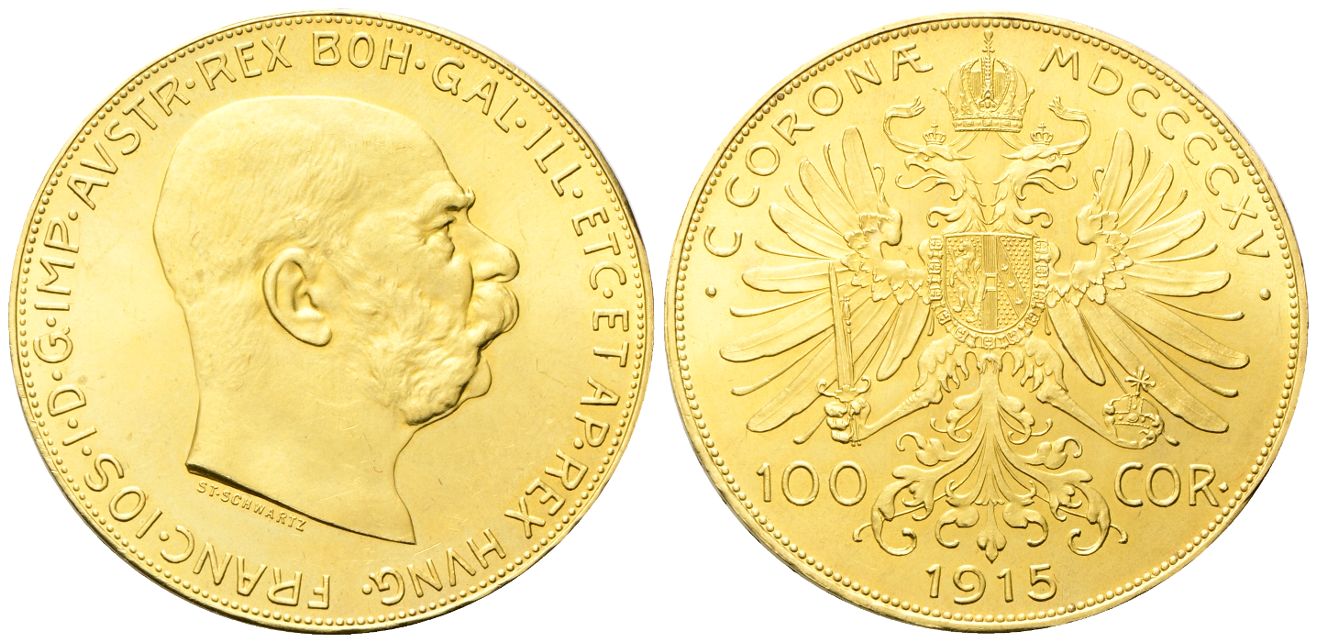
The obverse features the portrait of Franz Joseph I, and on the edge the legend, the “FRANC•IOS•I•D•G•IMP•AUSTR•REX BOH•GAL•ILL•ETC•ET AP•REX HUNC”
The reverse, however, has the imperial coat of arms superimposed at the two-headed eagle and on the edge, there is the legend “C. CROWN MDCCCCXV” while the lower is the value and year (1915).
On board, there is the inscription in Latin Vnitis Viribvs, “With the Forces United”, which was the personal motto of Emperor Franz Joseph.
The gold Crowns sono un’ ottima forma di investimento per privati e/o istituzioni che desiderino investire in oro fisico.
Come per i 4 ducati, la particolarità è quella di essere una delle poche monete che non presenta il segno della zecca austriaca di Vienna (Münze Osterreich).
As well as the 4 gold ducats 1915, is a type of coin of great charm in the eyes of collectors because it represents a great historical period antecedent to our own: it is, for this reason, bought and traded, especially in the european regions of the former Austro-Hungarian Empire.
In Lombardy, the Trentino, Friuli Venezia Giulia and Veneto regions of italy where this coin, to important historical and cultural reasons, is exchanged between the various investors and lovers of the metal gold.
The Münze Österreich AG began the minting of the gold Crowns in 1892when Franz Joseph I ordered a monetary reform. The first coins were carrying values of 10 and 20 crowns. In 1908, followed by the 100 Crowns, to commemorate the diamond jubilee of the emperor. The austrian mint stopped production of gold coins after the outbreak of the first world warin 1918, a date that coincides with the dissolution of the Empire. After the end of the First World War, the Kingdom of Yugoslavia and Czechoslovakia were the first states to abolish the Crown of the austro-Hungarian monarchy.
When the minting resumed in 1921, it was decided to the dating of the coins in 1915 to mark the last full year of the Emperor. Franz Joseph I died in 1916, so to commemorate his 68-year reign, all the riconi Crowns after that date are still inscribed with the year 1915.
Fu così che in quello stesso anno la zecca d’Austria decise di riconiare le 100 Corone d’oro in segno di commemoration.
For over fifty years, the Crowns austrian state one of the gold coins the most widespread on the market. Have been overcome by the Krugerrand south africancreated specifically for the market of private collectors. When the laws of the united states changed to allow private investment in gold coinsthe austrian mint increased production levels of the Crowns just to challenge the Krugerrand.
The Crown of the gold of Austria is coin investment very sought-after by collectors especially for her historical link with the past, which saw Austria-Hungary as one of the States most prevalent in Europe.